
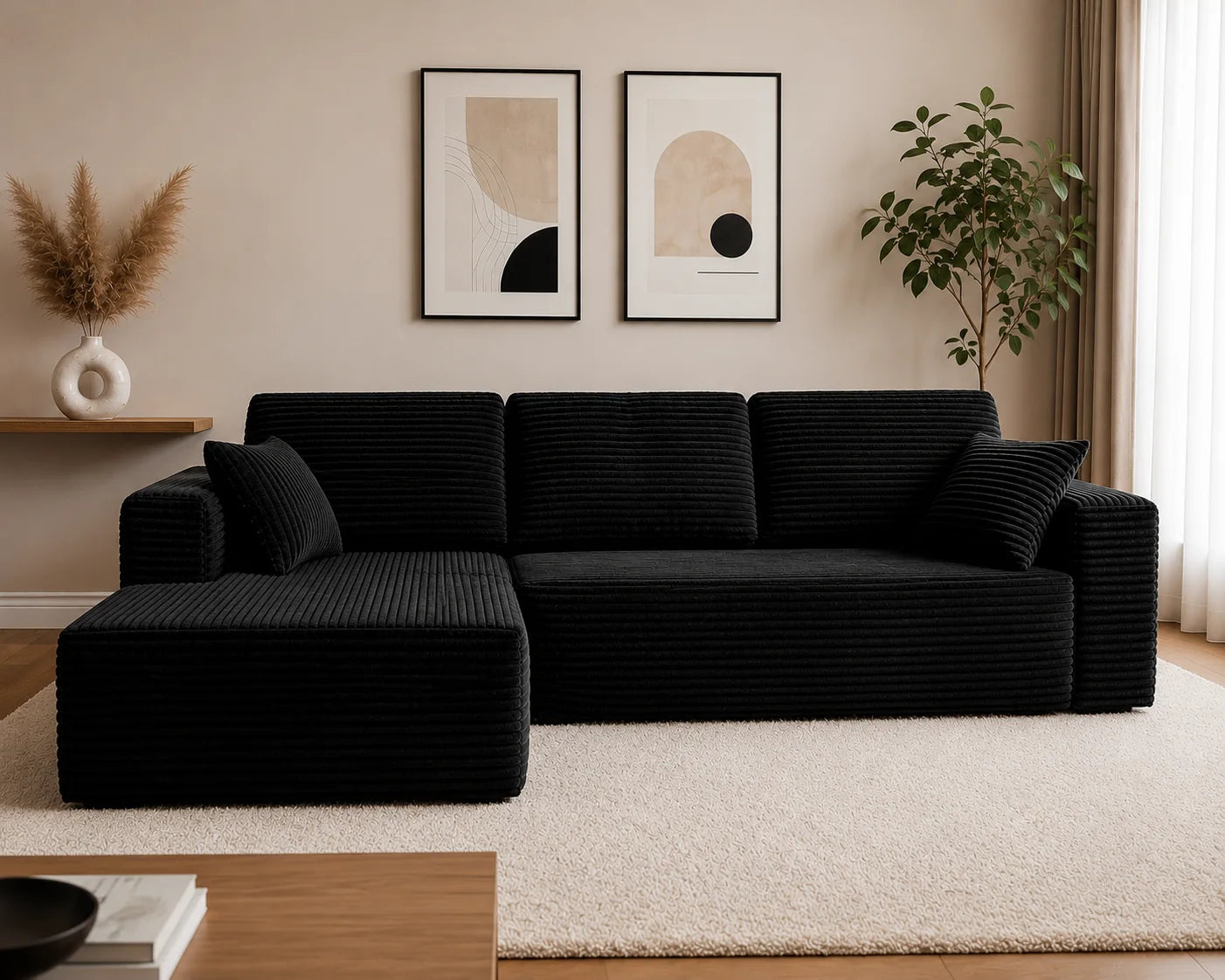
When we think of a sofa, we usually imagine a large, rigid piece of furniture: a wooden or metal frame, upholstery around it, and the entire structure somehow needing to fit through the door into the living room.
A frameless sofa approaches the same problem differently.
Instead of the sofa's shape depending on a large, rigid frame, its main body is formed by soft materials and supporting internal layers. This allows the sofa to be compressed significantly for transport. After opening the packaging, it gradually regains its usual shape.
This might seem a bit strange at first glance. How can a full-size sofa be compressed? Is it just a large foam cushion? What keeps it upright afterward?
Let's take a closer look.
Frameless doesn't mean unsupported
The word "frameless" might give the impression that the sofa consists only of soft foam. In reality, this is not the case.
For example, in the case of HIISE Hugo, the sofa's shape is provided by a soft interior and the pocket springs located within. There is no traditional large, rigid sofa frame, but this doesn't mean there's no supportive structure under the seating.
Pocket springs are individually working springs located in textile pockets. Under load, they can move partially independently, instead of the entire spring system moving at once.
In practice, this means that the sofa's soft interior doesn't have to bear the entire weight of the sitter alone. The springs add support to the seating and help distribute the load.
How does an entire sofa fit into a small package?
This is where the absence of a rigid frame comes into play.
The transport dimensions of a regular sofa are largely limited by its frame. You can remove the cushions and detach the legs, but the wooden frame itself cannot be made smaller.
With a frameless construction, a large part of the sofa's volume is compressible. For transport, the modules are compressed at the factory and compactly packaged. When the package is opened at home, the sofa regains its original shape.
This doesn't necessarily happen instantly.
For HIISE Hugo to fully regain its shape, up to 72 hours should be allowed. The sofa starts to take shape immediately after opening the package, but the materials need time to fully recover after being compressed for transport.
Therefore, a frameless sofa fresh out of its package should not be judged based on the first five minutes.
Why compress a sofa at all?
The most obvious advantage is easier transport.
When buying a large sofa, the problem is not always whether there is enough space in the living room. Obstacles can arise much earlier.
Does the sofa fit:
-
through the front door of an apartment building;
-
around the turn of the stairwell;
-
into the elevator;
-
into the apartment hallway;
-
through a narrow bedroom or living room door?
With a traditional rigid sofa, the narrowest possible passage is largely determined by the frame itself. If the rigid frame doesn't fit, options quickly become limited.
Packages for sofas with compressed modules are significantly easier to move. The packages are taken to the desired room, opened only there, and the sofa is allowed to regain its full size.
The frameless construction can also be helpful later when moving the sofa at home, as there is no large rigid frame. However, one should not expect that a sofa that has recovered its shape can be compressed to the same small size at home as it was upon arrival.
More compact packaging can reduce the costs and complexity associated with transporting large furniture. This helps offer a spacious sofa at a competitive price, without the buyer having to compromise on a full-size sofa.
For the customer, the advantage is broader than just transport. The sofa is easier to move into the correct room, and after opening the package, there is no need to assemble a frame, attach legs, or connect many parts. Buying a large piece of furniture therefore becomes simpler than usual.
Does a frameless sofa require assembly?
That depends on the model.
For some modular sofas, "module" means an entire list of brackets, legs, screws, and connections.
The idea behind HIISE Hugo is different. The sofa modules can be placed in position after removal from the packaging, and no conventional assembly is required.
There is no wooden frame to screw together, and no separate carcass to attach the seats to.
The biggest task is actually waiting. After unpacking, the sofa needs time to regain its shape.
Easier to maintain
The convenience of a sofa doesn't end when it's settled in the living room. In daily use, fabric inevitably collects dust, crumbs, and pet hair, and occasionally stains occur.
HIISE Hugo has a removable cover, which makes sofa maintenance more practical than a construction where the outer fabric is permanently attached to the sofa. The exact cleaning method depends on the fabric and its care instructions, but a removable cover provides more options for keeping the sofa in good condition.
This is especially practical in homes with children or pets.
Is such a sofa as durable as a conventional sofa?
There is no honest universal yes or no answer to this.
"Frameless sofa" describes a type of construction, not automatically quality.
Just as a regular sofa with a wooden frame can be very well or very poorly made, the durability of a frameless sofa also depends on the materials used, the construction of the internal support, the properties of the foam, the stitching, and how the entire structure withstands stress over time.
Therefore, when buying, it's worth looking beyond just whether the product is labeled "frameless."
The more important questions are as follows.
What's inside the sofa?
Does the entire seat consist of foam, or are springs and other supporting layers also used?
Is the cover removable?
A sofa is used for years. In real life, maintainability quickly becomes more important than how the product looks on the first day.
How long does the sofa need to recover after opening?
For compressed furniture, the manufacturer should be able to provide specific instructions on this.
What are the actual dimensions after recovery?
The package dimensions and the finished sofa dimensions are two completely different things.
Is a frameless sofa soft?
A frameless construction generally allows for the elimination of a large, hard frame surrounding the sitter. Therefore, the seating sensation of such a sofa can be softer and more relaxed than usual.
The absence of a rigid outer frame usually also means fewer hard edges and corners around the sofa. This can make such a construction a pleasant choice, for example, in homes where there is a lot of daily movement around the sofa.
However, comfort is not solely determined by the presence or absence of a frame.
The seating sensation is influenced, for example, by the density and thickness of the foam used, the type of springs, the seat depth, the backrest angle, and how different material layers work together.
That's why it's worth examining the construction of a specific sofa, rather than drawing conclusions based solely on its appearance.
For whom does a frameless sofa make the most sense?
The clearest advantage is for people for whom getting large furniture into their home is difficult.
For example, in apartments with small elevators, in old buildings with narrow stairwells, or in homes where the living room is accessed through an awkward angle.
Another reason might be the desire for a sofa with a softer and more relaxed seating sensation, whose construction doesn't resemble classical furniture with a rigid frame.
A frameless solution is not necessarily better for everyone. If you prefer a very firm and high seat or a sofa with a traditional construction, the classic option might suit you better.
It's important to know what you're buying.
A new construction, the same simple goal
Ultimately, even the most unusual sofa construction must do one very common thing: it must be comfortable to sit on.
The purpose of a frameless sofa is not just to be different. Such a construction helps solve one of the biggest problems of traditional upholstered furniture, which is its size and transport. And it doesn't mean settling for a smaller sofa at home.
HIISE Hugo uses a compressible frameless construction, soft interior, and pocket springs. For transport, the sofa modules can be compactly packed, and after opening, they gradually expand to full size.
As with any sofa, the actual quality of a frameless sofa is ultimately determined by the materials, construction, and how they hold up during long-term use. Therefore, it's worth looking beyond just the appearance or package size and examining what's actually inside the sofa.
The biggest idea behind a frameless construction is simple: a full-size and spacious sofa doesn't necessarily mean a large, rigid piece of furniture whose delivery to your home is a project in itself.